The solo only a human can play
If you have read my blogs before, you probably know about my passion for sports, and for Michael Jordan in particular. But there is a second passion I rarely write about, and that is music. Not just any music, but the kind that truly makes an impact, at least on me. And the more I think about it, the more I suspect these two passions are not so far apart after all.
Some music stays with you your whole life, and for me that music is November Rain.
I was born in 1975, and the music of that era settled in early and never really left me. Bohemian Rhapsody was released the year I was born, and November Rain came along when I was a teenager and old enough to feel it. Even now, whenever that piano intro starts, I find myself stopping whatever I am doing just to listen.
Over the years I have come to understand that these songs are more than just my favourites. Without me really noticing it, they have taught me quite a lot about who I am as a person and about what truly matters to me, but also about my own craft as a software engineer.
The anatomy of a great composition
If you listen closely to November Rain, you notice how carefully it has been built.
It never seems to be in a hurry. It opens with that gentle piano intro and takes its time, layering and growing and holding back, before it finally arrives at the guitar solo that everyone remembers. The whole song lasts almost nine minutes, and yet it never feels too long, because every part is there for a reason.
For me it is the two extremes that make it work. The quiet piano and Slash’s soaring guitar are opposites, and it is exactly that contrast which creates the build-up and the balance of a perfect composition. Take either one away and the whole thing loses its shape.
Bohemian Rhapsody does something equally daring in its own way. It happily ignores the rules, weaving a ballad, a piece of opera and hard rock into a single song, and somehow it all belongs together.
What these compositions have in common is that they are truly composed. There is structure, there is dynamic, there is a build towards a climax and a return to calm. And none of it happened by accident or in a single take. Someone sat with it for a long time, rewriting, moving a part here and removing a part there, until it finally felt right.
To me that is craftsmanship, and it is exactly the kind of craftsmanship we practise as engineers.
Our work is a composition too
When I think about it, a good system, a good project, even a good career has a similar shape.
There is the quiet beginning where you lay the foundations, often with little to show for it yet. There is the long middle where most of the real work happens, and where a lot of it is not glamorous at all. And there is the tension when things get difficult, followed by the satisfaction when everything finally comes together. Just like a great song, it is built on patience, attention to detail, and a sense of timing that is hard to put into words.
Here too, you rarely get it right the first time. You rewrite, you let go of the clever solution that do not serve the whole, and you keep adjusting until it feels right.
If I am honest, that endless adjusting has another side to it as well. I almost always feel that what I have made is not quite good enough, and somewhere in the back of my mind sits the fear that one of the truly great engineers will look at my work and, with a remark or two, quietly expose me. For a long time I saw that feeling as a weakness. These days I am not so sure anymore. Maybe that quiet doubt is simply the other side of caring about the craft, the same thing that makes you rewrite a part until it finally feels right instead of settling for something that merely works.
In that sense, the best engineers I know are a little bit like composers. They care about how all the parts fit together, not just whether the code happens to run.
More than the tools
I use AI, and I believe in its value. It has become a real part of how I work.
But when I am honest about it, I am first and foremost a craftsman. What drives me is not the newest tool, but a passion for our profession and for craftsmanship itself. And it is easy, in all the excitement around AI, to let the human side of our work quietly slip into the background.
I think that would be a mistake. The more our tools can do, the more the things that are truly ours begin to matter. Which problem is actually worth solving. What "good enough" means for the people who have to live with the software we build. When to keep going, when to stop, and when to say that something is not right even though the numbers look fine. Those choices come from experience, judgement and care, and I do not believe they can be automated away.
November Rain works because a human being decided it was allowed to take almost nine minutes, to unfold slowly and give the guitar the room it needed instead of racing to the catchy part. Axl Rose reportedly carried this song with him for the better part of a decade, reworking it long before it ever reached a studio, until it finally sounded the way he heard it in his head. Freddie Mercury did much the same with Bohemian Rhapsody, carrying it around in his head and on scraps of paper long before he pieced it together in the studio. No tool asked either of them to spend those years on it; they did it because they cared about getting it right. It was a choice made out of feeling rather than efficiency, and that is exactly what gives it meaning.
The solos, and the man playing them
For me it always comes back to the solos, and to the man playing them.
November Rain does not settle for a single solo at the end. The guitar keeps returning throughout the song, each time saying a little more, and it builds all the way to that final, unforgettable solo long after most songs would already have faded out.
And this is really where Slash comes in. If you have ever seen the video, you know the image: the top hat, and Slash stepping out of a small chapel in the middle of the desert to play. There is no crowd out there to impress, no reason for it other than the music itself. He simply stands in the open and plays, and somehow every note carries more feeling than a page of lyrics ever could.
I saw this up close twice in the past year, once in Germany and once in the Ziggo Dome. What struck me both times is that, even though Axl’s voice falters here and there after all these years, every note Slash plays is perfect. Really, every note.
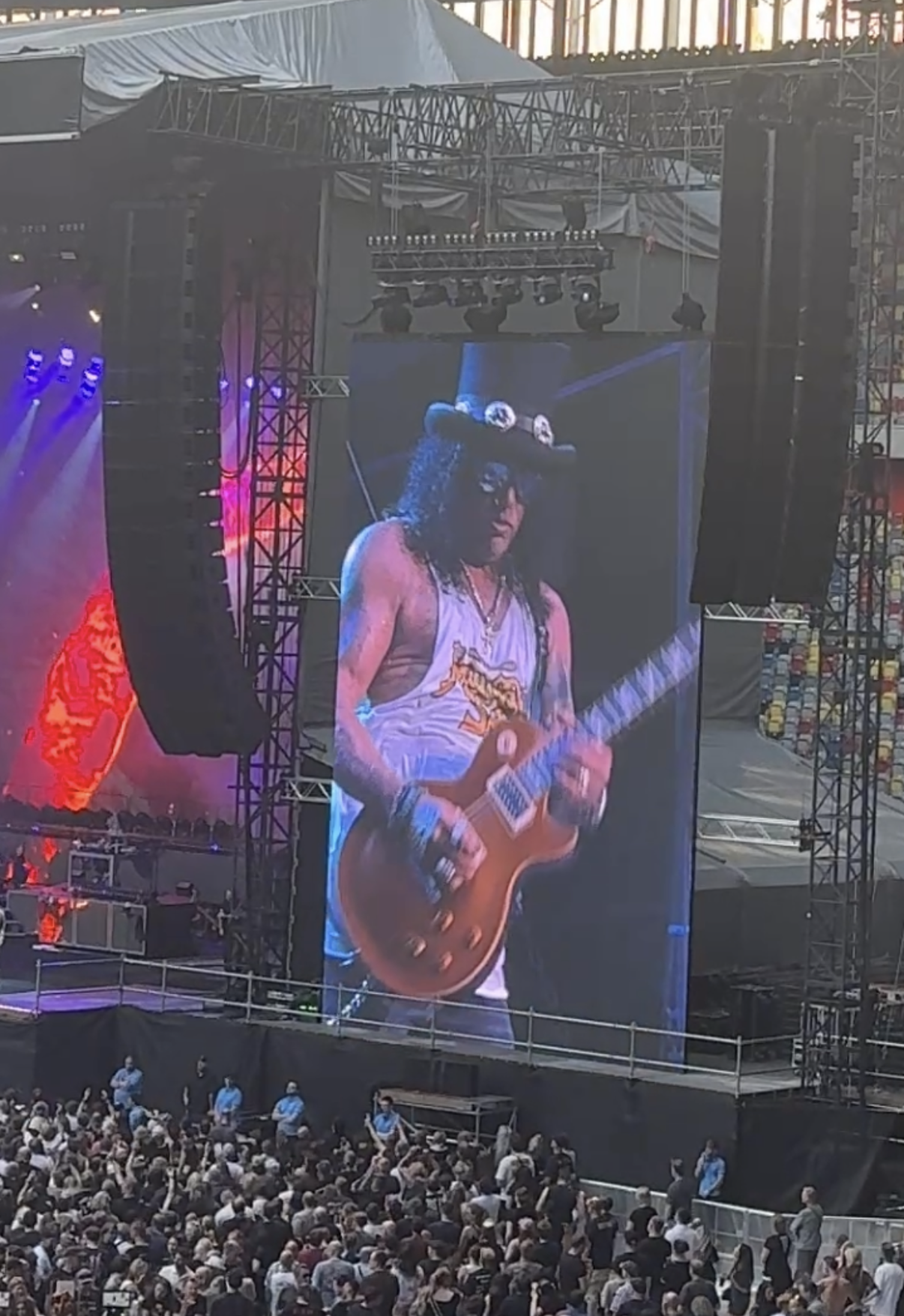
Slash is a magician on the guitar. What he plays is not only technically brilliant, it is deeply felt, and that is the part that stays with you long after the song has ended. Those solos are not there to be efficient or to add information. They express something that the words and the structure on their own simply cannot. They are pure emotion, and they are the moments the whole composition has been quietly building towards.
That, to me, is exactly what sets us apart as being human. In theory you could describe every note of such a solo, feed it to a machine, and get back something that plays the same notes in the same order. It would be technically correct, and yet there would be no life in it. What gives a solo its meaning is that a person truly felt it and meant it. Slash does not move us because he found the best possible sequence of notes; he moves us because he means every single one of them.
I believe the same is true for the work we do. The tools can play the notes, and they are getting better at it all the time. But the essence, the emotion and the judgement behind our choices, the part that actually moves people, is ours. That is not a weakness we should apologise for. It is the very thing that makes our work worth doing.
Still ours to play
I still stop whatever I am doing when that piano intro begins, and by now I understand why.
These songs remind me that craft and emotion are not opposites, and that reason and feeling do not have to compete. The best work, whether in music or in software, is the place where all of it comes together, made by someone who cared enough to get it right.
We have great tools at our disposal, and we should use them as well as we possibly can. But somewhere in every good engineer there is a bit of Slash walking out into that desert: doing the work not because a metric asks for it, but because it means something. The solo, the one that truly moves people, is still ours to play.
